Click on the links below
| To access the Shopping Cart FAQ / Help info click here: Shopping Cart FAQ |
| Email accounts are created from your siteadmin which can be accessed at: http://www.your-store.biz/siteadmin/ (substitute your actual domain name in place of your-store.biz)
|
| Once your domain is resolving to our servers you will also be able to retrieve your email using the web based email at: http://www.your-store.biz/webmail/ (Where you would substitute your actual domain name in place of your-store.biz. )
Click here to view the webmail demo, or continue reading below. The first time you log in, the webmail will prompt you to configure your personal settings. You can generally leave the default settings. On the next page you will want to click on the small gear icon (User Preferences). Near the top of the page, the third field shows the default “From” address. From the dropdown select as your default the new email address (without the www in it) that you have created. Then scroll down to the bottom of the page and click Save. Setting your webmail account to delete messages marked as SPAM |
| In order for you to use the SMTP services of your account, you will have to check your email at least once prior to attempting to send email. (If you use a dialup provider, it is likely that you are assigned a different IP address each time you go online. If so, then you will need to check your email at least once each time you connect to your dialup provider.)Once you’ve checked your email, you may then use your domain to send email to other locations.After getting disconnected and then reconnected to your dial-up provider, your operating system may remember the IP address of your previous log-on. If you have trouble sending mail after a dial-up disconnect, you may have to reboot your computer to clear the settings.Alternately, a good long term solution would be to type in the SMTP settings of your local ISP in the “outgoing mail server” field of your email software. Also, you can read and send and receive email from your online mail reader at: |
| The SPAM ASSASSIN is a software program that reviews email that is being sent to you. This program is designed to either delete the SPAM before it reaches you, or to change the subject of suspect emails to **SPAM** and converts any html messages to plain text, thereby disabling any harmful javascript or tracking images the message may contain.
The way it determines whether a message is SPAM is based on a point system; a database of words and attributes has been created (and is constantly being updated). When a message is sent to you, the SPAM ASSASSIN software reviews the message and gives the message score (a point for each suspect word or attribute the message may have). If the score is above 6, the message is marked as SPAM. The SPAM ASSASSIN software is also customizable. The site administrator may access the SPAM ASSASSIN settings for all users from the /siteadmin. Depending on the SPAM ASSASSIN version, you would either click on pencil icon, and then the SPAM ASSASSIN tab, or You may disable the SPAM ASSASSIN, but we believe, based on a group of domains already using the program (including our own) and a number of requests we have received for such a program, that you will be pleased with the SPAM elimination solution. One good way to handle the email marked as spam is to set up a mail rule within your email software to automatically move all messages with **SPAM** in the title to a separate folder. That way you never have to see the messages but you can look back through them if necessary. If you are using Outlook Express, you would click Tools –> Message Rules –> Mail and then click New to add a new mail rule. In addition to moving messages with SPAM in the subject line to a separate folder, it would also be a good idea to have it test for other common spammer subjects. E.g. viagra, etc.. For further information on spam reduction, please read on below. |
| Greylisting: We can also set up your domain to send all your email to a separate mail server which we have set up with greylisting software. What greylisting does is tell the sending mail server that the message is deferred and to “Please try again”. If the same mail server tries again 5 minutes later then the email will then get through to you. All RFC complaint mail servers will try again and you will then get your email. Most virus and spam sending software does not wait to hear the “deferred” response and they will not try again. Using greylisting will cut your spam by 2/3. If you would like us to set this up for your domain, please submit a support ticket.
Spammers get your email address from a few sources, mainly newsgroup postings, lists sold to them by FFA (Free For All Links) sites, by spidering web pages where you list your email address, and by sending email to common names @yourdomain.com (and then checking for bounces). Also, many times spammers will send out email without a complete “From” address (not containing an @). In that case our mail server will append the server name @dnssys.com or @secure-acces.net etc. to the “From” address. This makes it look like we, your hosting provider, are sending the spam. We are definitely not sending it nor have we sold your email address. Other useful links: |
| Every computer should have software installed to prevent virus infection. A popular software package is the Norton Antivirus from www.norton.com
Also, if you believe you have a virus you might want to check your computer with the free virus checker available from http://housecall.trendmicro.com/housecall/start_corp.asp Most times viruses will send themselves out with fake “From” addresses. So, virus email that bounces back to you may not actually have originated from your computer. |
| You can install many CGI scripts in your local cgi-bin. Keep in mind that cgi scripting is a programming tool. Problems resolving from these and other cgi scripts are not covered under technical support. A few common parameters that you may need in installing your cgi script are:First line of perl scripts should be: Your base directory:/home/sites/www.your-store.biz/web/ (where you would substitute your actual domain in place of your-store.biz)The location of our sendmail program is:
The location of our date program is: Tips for CGI Installations If you need help installing or writing custom cgi scripts you may wish to contact one of the following group of programmers who will get you up and running at a minimum cost. They will give you an estimate for the job you wish to have written or fixed. The scripts below are fairly easy to install and come with installation documents. |
| To learn more about working with the pre-installed WordPress script on your site, please click the link below: WordPress Help and Tutorials |
| Your site is already configured for the placement of counters. A counter may be added to your page by including the following line in your html document. Make sure to change “anyname.dat” to the datfile name you’d like to use for your site (It just needs to end in .dat).
<img src=”/cgi-bin/Count.cgi?ft=5|dd=C|frgb=255;255;255;&df=anyname.dat”> For additional counters simply add your login_name1, 2, 3, etc… You can modify the look of your counter by changing the following values: ft=size of frame around counter dd=A,B,C,D,E – you can try different ones frgb=color of frame For additional counter styles click here. <img src=”/cgi-bin/Count.cgi?ft=1|dd=A|frgb=255;255;255;&df=anyname.dat”> |
| If you would like to create a form that uses our built in fmail.pl form mailer, the easiest way to create a form page is to start with one of the form pages on our site Edit it for your needs, rename it, then publish it to your site. For syntax information for use with the fmail.pl script please click here. The recipient address needs to se something@your-store.biz
If you use a software package like Front Page then you would just use the built in form maker and follow the instructions within FP. For information on how to use the fmail.pl script with Front Page, click here. |
| Alternative 1 – secure-access.net server 1. Request a secure directory on the secure-access.net server. Click here to request secure directory. We will set up the directory for you and email you the FTP settings for it. 2. Set up the form on your site using the fmail.pl script. If you are using Front Page you will have to choose the custom cgi script handler in the form settings, or paste in the html. For information on how to use the fmail.pl script with Front Page, click here. 3. Set the form to email the secure information to the secure email address on the secure-access.net server. You will be able to read that email securely using the secure mail reader at https://www.secure-access.net/neomail/ |
|
| Alternative 2 For a one time setup cost of $200 (all inclusive) and an additional $20 per month we can purchase and install your own secure certificate from Thawte. We will then set up a separate site like https://secure.your-store.biz where you can put your forms, scripts etc.. To order your secure certificate and site click here. |
| All Precision Web Hosting accounts include a newsletter script. Pre-installed on your site is a newsletter.html page (for instance, http://www.precisionwebhosting.com/newsletter.html). This page contains a simple form where visitors may subscribe, or unsubscribe, to your site’s newsletter. IMPORTANT NOTE: you can take the simple form from the Source Code of the newsletter.html page and put it on any of your other pages (see http://www.gcwoodworks.com/woodworking _free_ezine.htm as an example). The form generally looks like this:
<FORM ACTION=”http://www.precisionwebhosting.com/cgi-bin/easylist.cgi” METHOD=”POST”> You would simply need to paste the similar code into the the html code of your pages. To send out a newsletter, in your Web Site Settings email is a url for logging in to see your newsletter list and a place to create a text message to send to your subscribers. This is strictly an opt-in list, so you cannot manually add email addresses from the administration page. If you have an opt-in list from your previous hosting company and you want to use it, you would need to download the /cgi-bin/Data/emaildata.log file (using ASCII mode) on your site insert the emails (one email address per line) and then re-upload it to /cgi-bin/Data/emaildata.log To learn about your shopping cart newsletter (a separate newsletter feature), click here. |
| If you are having intermittent problems accessing your site, please read the following:
1. To independently monitor your site, you might use http://netmechanic.com/monitor.htm 2. To help trace problems with Internet traffic, try the following: Mac OS X Environment d.) Your screen may output information that looks like: Tracing route to example.com [1.1.1.1] over a maximum of 30 hops: 1 123 ms – 123 ms -123 ms – 38.1.1.1 This is called a traceroute, which traces, hop for hop, all the jumps you take from your internet connection to the destination. The first few hops are usually through your service provider’s network. The hops from there are usually through the backbone/upstream provider your service provider uses to route internet traffic. The last few hops will be with our upstream/backbone provider through our network and to your server. Each hop shows timing information (designated by 3 sets of ‘ms’ ratings). Timing below 300 ms is good timing. Anything above that up to 1000 ms indicates some delays which will ultimately affect your overall connection performance. Any ‘ms’ timings represented by an asterisk (*) indicate a time-out (bad connection). Whatever hops shows asterisks or timings above 500 will, more than likely, be where your connection is having problems. Check with the appropriate people regarding any performance problems. If the problems occur, in the first few hops, it is your service provider. If the problems occur within the midway hops, it is your service provider’s upstream/backbone connection. If the problem occurs within the last few hops to your site, then it is a problem on our end. Please note, if the problem occurs in the first few hops, it will affect most of the hops thereafter. An alternate location to do a trace route from is: http://www.geektools.com/ |
| Click the links below to go to the FTP tutorial you wish to view:
Or, FTP using your Internet Explorer browser 3. From the Internet Explorer menu select Page, then “Open FTP Site in Windows Explorer”, and enter your login username and password once more. 4. Now you will be able to paste files or drag files into the Windows Explorer FTP window that you have opened. You will also be able to delete and rename files. The directory that you will want to put your files into is the /web directory. Any files that you put in /web will show up on your site. For example, if you upload somefile.jpg to /web then the file will be visible at http://www.your-store.biz/somefile.jpg (not http://www.your-store.biz/web/somefile.jpg) |
| Click the links below for the DreamWeaver tutorial you wish to view: |
| The steps to publish with Microsoft Publisher 2003 are: 1. Click File –> Save That will save your Publication on your computer; that will normally be in your Documents folder.2. Then click File –> Publish to Web Where it asks you for the file name put your web site address like http://www.your-store.bizMake sure to substitute your actual domain name in place of your-store.bizWhen it prompts you for a user and password you will enter “webmaster” as the username. The username and password would be the same as you would use for publishing using FrontPage. user: webmaster Password: same as your FTP password After that password prompt disappears, the the file name shows “index”; leave that and click Save
|
| When you FTP files to your site or publish Using FrontPage, the changes are made immediately on the server. However you might not see the changes for 2 reasons: 1. Your browser is showing you an old page that it has cached on your local hard drive. To force the browser to reload the current page form the server, hold down the <SHIFT> key while you click on the Reload button (Netscape) or Refresh button (Internet Explorer). Or, if you are using the built in AOL browser, hold down the <CTRL> key while you click on the Refresh button (Normally just to the left of the address bar and Home Icon).2. Another possible reason you are not seeing your changes: If you are working on your home page and your home page was named index.html but you now have it named index.htm of Default.htm, you might be changing the index.htm page but still seeing the index.html page. index.html has a higher preference than index.htm as a home page. To resolve this, just rename your home page to index.html |
|
The steps to add an auto responder are: 1. If you have not created the email user that you would like to have the autoresponder on, add it. The help on adding an email user is at: www.precisionwebhosting.com/siteadmin-demo.htm Once it is set up, and email sent to that address will get an automatic response emailed back. This can also be used with information request forms to automatically have the information mailed to the customer. |
||||
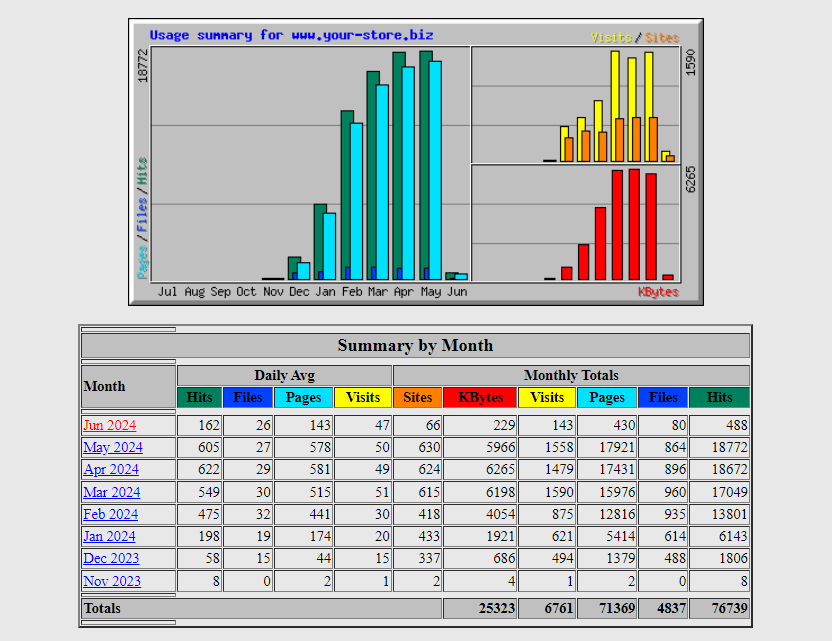
| You will normally access your statistics at: www.yourdomain.com/admin/ (where you would substitute your actual domain instead of “yourdomain.com”The username and password to log in will be the same as for your siteadmin. You would click Usage –> Webalizer or AWStatsMain Headings Hits represent the total number of requests made to the server during the given time period (month, day, hour etc..).Files represent the total number of hits (requests) that actually resulted in something being sent back to the user. Not all hits will send data, such as 404-Not Found requests and requests for pages that are already in the browsers cache. Tip: By looking at the difference between hits and files, you can get a rough indication of repeat visitors, as the greater the difference between the two, the more people are requesting pages they already have cached (have viewed already). Sites is the number of unique IP addresses/hostnames that made requests to the server. Care should be taken when using this metric for anything other than that. Many users can appear to come from a single site, and they can also appear to come from many ip addresses so it should be used simply as a rough gauge as to the number of visitors to your server. Visits occur when some remote site makes a request for a page on your server for the first time. As long as the same site keeps making requests within a given timeout period, they will all be considered part of the same Visit. If the site makes a request to your server, and the length of time since the last request is greater than the specified timeout period (default is 30 minutes), a new Visit is started and counted, and the sequence repeats. Since only pages will trigger a visit, remotes sites that link to graphic and other non- page URLs will not be counted in the visit totals, reducing the number of false visits. Pages are those URLs that would be considered the actual page being requested, and not all of the individual items that make it up (such as graphics and audio clips). Some people call this metric page views or page impressions, and defaults to any URL that has an extension of .htm, .html or .cgi. A KByte (KB) is 1024 bytes (1 Kilobyte). Used to show the amount of data that was transferred between the server and the remote machine, based on the data found in the server log.
A Site is a remote machine that makes requests to your server, and is based on the remote machines IP Address/Hostname. URL – Uniform Resource Locator. All requests made to a web server need to request something. A URL is that something, and represents an object somewhere on your server, that is accessible to the remote user, or results in an error (ie: 404 – Not found). URLs can be of any type (HTML, Audio, Graphics, etc…). Referrers are those URLs that lead a user to your site or caused the browser to request something from your server. The vast majority of requests are made from your own URLs, since most HTML pages contain links to other objects such as graphics files. If one of your HTML pages contains links to 10 graphic images, then each request for the HTML page will produce 10 more hits with the referrer specified as the URL of your own HTML page. Search Strings are obtained from examining the referrer string and looking for known patterns from various search engines. The search engines and the patterns to look for can be specified by the user within a configuration file. The default will catch most of the major ones. Note: Only available if that information is contained in the server logs. User Agents are a fancy name for browsers. Netscape, Opera, Konqueror, etc.. are all User Agents, and each reports itself in a unique way to your server. Keep in mind however, that many browsers allow the user to change it’s reported name, so you might see some obvious fake names in the listing. Note: Only available if that information is contained in the server logs. Entry/Exit pages are those pages that were the first requested in a visit (Entry), and the last requested (Exit). These pages are calculated using the Visits logic above. When a visit is first triggered, the requested page is counted as an Entry page, and whatever the last requested URL was, is counted as an Exit page. Countries are determined based on the top level domain of the requesting site. This is somewhat questionable however, as there is no longer strong enforcement of domains as there was in the past. A .COM domain may reside in the US, or somewhere else. An .IL domain may actually be in Israel, however it may also be located in the US or elsewhere. The most common domains seen are .COM (US Commercial), .NET (Network), .ORG (Non-profit Organization) and .EDU (Educational). A large percentage may also be shown as Unresolved/Unknown, as a fairly large percentage of dialup and other customer access points do not resolve to a name and are left as an IP address. Response Codes are defined as part of the HTTP/1.1 protocol (RFC 2068; See Chapter 10). These codes are generated by the web server and indicate the completion status of each request made to it. |
| Your domain is set up with the FileMan software which allows you among other functions, to password protect a directory. The steps would be:
1. Log into the FileMan software at your-store.biz/cgi-bin/fileman/fileman.cgi (substitute your actual domain name in place of your-store.biz) 2. Once logged in, if you see a web directory link, you should click it. (The software may automatically start you off in the /web directory) 3. Browse to the directory that you want to protect, or create that directory. 4. Click on the “Protect” link near the top of your screen. Then, near the bottom of the screen, fill in the desired values in the username and password fields and click the “Add User” button. If you are using FrontPage, then the directory ownership might not let the FileMan software create the .htaccess file necessary for password protection. In that case you may want to use the FrontPage built in password protection function. To use FrontPage to password protect a directory:
|
| For Information on registering your site with the search engines click here. |
| What are the meanings of all those internet terms? Click here to find out. |
|
| Open up the hosts file on your computer using Notepad. If you are using Windows Vista, you will need to right click on the Notepad selection from your programs menu and select “Run As Administrator” then click “Continue” when prompted. Then browse to that directory, and select to view “all files” not just .txt files. The hosts file that you will need to edit is generally at: c:\windows\system32\drivers\etc\hosts NOTE: hosts is the name of the hosts file and not another directory name. It does not have an extension (extensions are the .exe, .txt, .doc, etc. endings to filenames) and so appears to be another directory in the example above. The 2 lines that you will need to add to the end of your hosts file are below. (Make sure to type in your actual domain name instead of yourdomain.com, and instead of typing in 209.216.xx.xxx you’d type in the actual server IP address. # The 2 lines to insert are below 209.216.xx.xxx www.yourdomain.com 209.216.xx.xxx yourdomain.comIf you do not have a Hosts file already, you may simply create one.After making the changes, save the file, then close any browser windows that you may have had open, and restart Internet Explorer. If the changes took effect you should now see your site from our servers at www.yourdomain.comYou can check this by going to the url below (make sure to substitute your actual domain name instead of yourdomain.com) www.yourdomain.com/hosted-by/ Note: once you have changed the DNS/nameserver information for your domain, it should start resolving ot our servers within 1-24 hours after that time. Once it is resolvig to our servers you should remove the entries you have made in the hosts file on your computer. Once you make the changes above you will be able to publish your pages/files/images to your site on our servers using FrontPage.
|